I saw an anonymous post in the “I Teach High School” Facebook group in which I am I member. This post was asking for help regarding an individual with Down Syndrome (DS) in a choir that wasn’t matching pitch and was singing too loudly possibly because of hearing loss. I would first like to applaud this teacher for being courageous enough to ask about a challenging subject. I wanted so badly to respond in writing with a comment to their post. However, rather than reduce my thoughts to a single FB comment, I offered a phone conversation and then thought that maybe a blog might help.
I want to say right now that I do not have all of the answers. What I offer is not the be all, end all advice on working with those with DS. I am just speaking as a parent of a now 12 year old with DS and as a music educator celebrating differentiated instruction for 20 years. I hope this post will help foster conversations regarding benefits of singing in a choir for all and encouragement for all choir directors to continue to be more inclusive.
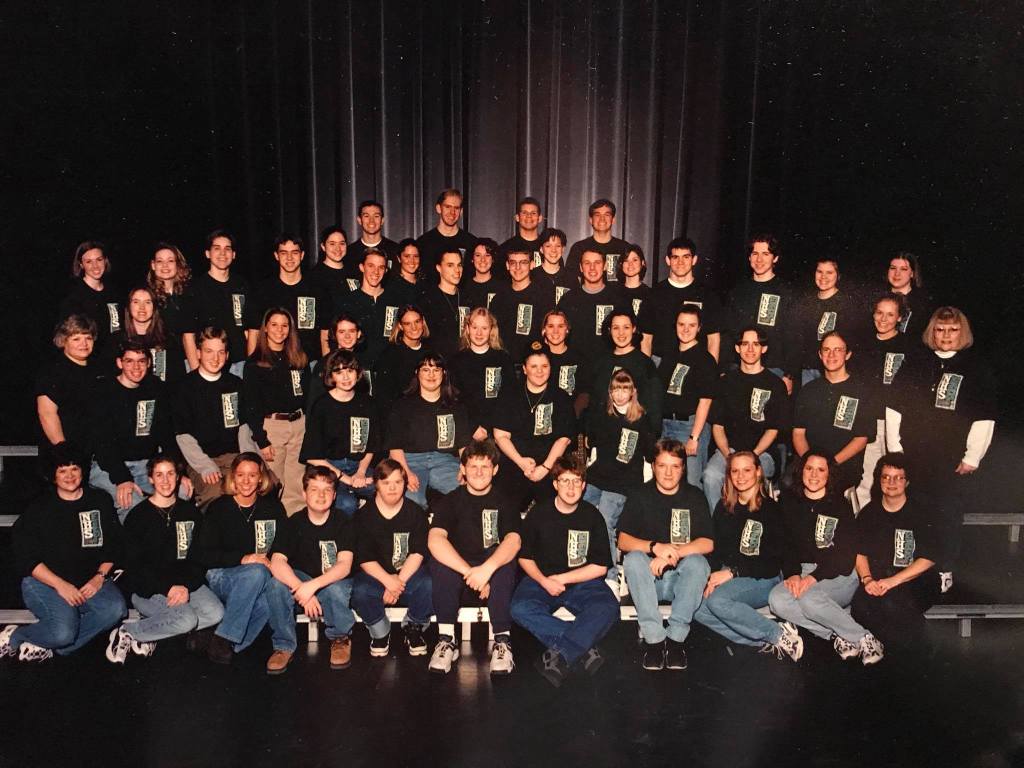
To give a little context of my pedigree, long before I was married or even before I knew that I wanted to be a choir director, I was exposed to performing with those with disabilities by my incredible high school choir teacher, Deborah T. Wittstein.(Choir pictured above….I’m in the back row far right with lots of hair!)
Our show choir would meet once a week during our built in study hall time to rehearse Disney tunes with a group of students with disabilities called “P.A.L.S.”. It was an acronym for “Practicing Adult Learning Skills”. Our rehearsals contained a lot of community building before we sang Disney songs with some light choreography. We actually went and performed together in Disney World!!! I just have to say that this concept was so incredibly cutting-edge at the time. The members of the choir would say hi to the PALS out in the community and they eventually stayed in touch after graduation.
Brittany

Early in my career before my wife and I had kids, I had a high school student with DS in my class named Brittany. She visited my class to see if she could participate and we discovered that if she stood in the Soprano section, she matched pitch every time! We then discovered that if a very mature soprano voice sang with her, she basically turned into Susan Boyle with a very warm mature vibrato. Brittany ended up singing the National Anthem at the Special Olympics basketball game with me standing behind her facing the opposite way singing in my falsetto. Here is a picture of Brittany post graduation singing with her Church’s praise team! Choir can be something individuals with DS can benefit from for the rest of their lives!
Sylvie
This brings me to my daughter, Sylvie. She loves to sing, dance and act. She also has Down Syndrome. You can hear my wife in the background teaching violin lessons. Our house has always been filled with music. This is a song we had practiced after learning it at a Gigi’s Playhouse class.
One of the main characteristics of those with DS is low muscle tone. This makes anything physical more challenging. I will use walking as an example. Can individuals with DS walk? Of course. Does it often take extra care, attention and work to make that happen? Yes. Does this mean they don’t enjoy going on walks or playing sports? Of course not! Singing is no different. Although singing provides access to music with a gentler learning curve compared to say playing an instrument, it still has it’s challenges and it’s own timeline for success for those with DS.
It takes a certain coordination of muscles to access one’s singing voice. Do you believe everyone that wants to match pitch can match pitch? I do. It’s just not going to happen as fast as your typical students. But if the student wants it to happen, and has a teacher that will continue advocating for them, they will match pitch. Just like if a typical student is not matching pitch or singing loudly, the teacher will address it in the best way they know how and continue to seek out advice. After they have gone down the arduous day-in and day-out grind of working on improving their voice and there is improvement, there will be great cause for celebration!!!
A by-product of having an individual with DS in the choir is that the other members of the choir will learn about empathy and will turn into cheerleaders as well. This is a tough lesson to learn and to consistently teach. Inevitably, helping the classmates understand will need to be part of the equation and you will need to carve out some time for it.
We have seen with Sylvie that being in a choir can help foster social relationships that will extended well beyond the classroom. When you perform with others, there is a bond that you will not find from being say in a math classroom (Sorry, Math teachers!). In addition to social benefits, a choral rehearsal provides many opportunities to help improve speech especially with texts that aren’t familiar to our everyday vernacular. The repetition of rehearsing a specific text will help develop those speech muscles. Singing all sorts of texts will also help with fluency and literacy, and will build confidence that will spill over into other subject areas.
Sylvie loves routine. The routine of having a before school choir in elementary school was sometimes the highlight of her week. It was something that her awesome music teachers at school did not have to invite her to, but Mr. Sennett and Ms. Reynolds did just that. In those first performances she didn’t have the confidence to get up in front of an audience so she sat with us and cheered her classmates on. Eventually she started standing backstage during the performances with her headphones on, performing but out of sight. This is a testament to the power of meeting a child where they are and giving them space so that they can reach the next attainable goal.
This video above is when she joined the group’s performance for the first time. You can see her delight in receiving applause and knowing full well that she overcame her fear of performing. Sylvie now has the confidence to audition for the middle school musical. She did and was accepted into the ensemble!!! She has now been in three different productions! Here is a clip from her audition video. She is most confident right now with a vocal track playing with her. Having strong singers around her helps her stay in her singing voice.
Strategies
Here are some strategies that I have found to be helpful to reach those with DS. A lot of this comes from working with my daughter and rubbing shoulders with other parents in the DS community. Every child is different and there isn’t a formula. There are much smarter people, educators and advocates out there that can chime in on this and I hope they do!
- Talk to students as if you would anyone their same age No baby talk). This includes constructive criticism. Do not be afraid to offer it. Have high standards.
- Notice if they have organically acquired a buddy or support group in the class. Ask this person or group if they can help the individual by sitting with them when directions may get confusing. This will also foster a core group for the individual socially.
- Provide very visual prompts. Maybe a stoplight poster (Red/Yellow/Green) to show how the volume or vowels or tone is in a section. “Uh-oh altos, looks like we are starting to dip in the red (pointing to stoplight). Make sure everyone is singing the same level.” If it happens again, go up to the child and inform them that they are in the red zone and should sing a little less. This can also be a gesture or hand sign that you and the student have agreed upon. You know your students the best, try something and include the parents in on it. Parental support at home can help reinforce.
- Stick to a routine. Have the order of class posted. It rocks a kid with DS’s world when the routine goes out the window.
- Stay positive. If you come from a place of negativity, students pick up on that and won’t realize their potential.
In summary, for choir teachers reading this, try to create space for anyone that wants to sing in your program. It may not be the most polished product, but the impact is beyond understanding. Keep encouraging. Totally worth it.
For non-choir directors reading this, do me a huge favor and please don’t ever ever ever say that someone can’t sing. Little ears hear that and they will think that they can’t sing either. Anyone that wants to sing can learn how to sing. In my twenty years of teaching, this has been proven over and over again. No exceptions. This is a hill that I am willing to die on. I would love to discuss with anyone on this matter. Where there is a will, there is a way.

 Tyler Merideth